
AED Voice Prompts Explained: Austin Guide
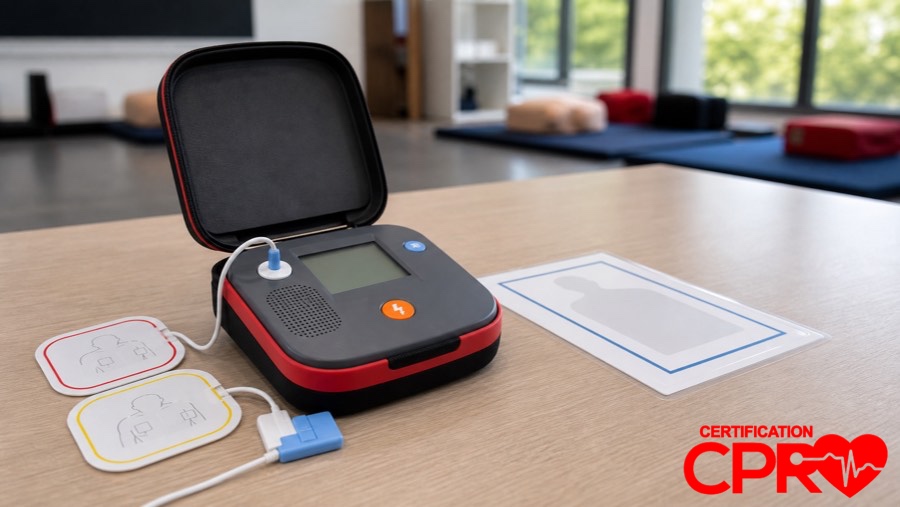
AED voice prompts exist for one reason: to keep a stressful, messy scene moving in the right direction. When someone collapses and bystanders are trying to help, the prompts remove the guesswork. They tell you what to do, in what order, and give you a small window after each instruction to act before the next one comes. That rhythm is what makes AEDs usable by people who have never touched one before in an actual emergency.
Each major AED prompt has a physical action behind it. Once you understand what the device is asking for, the voice stops sounding like a mystery and starts sounding like a step-by-step coach. If you want hands-on practice with a real device and instructor feedback, the AHA BLS CPR class covers AED use as part of the full course.
AED voice prompts are built for the person who is suddenly in charge before EMS arrives. In Austin, that person might be a gate agent at AUS, a coach at a youth sports field, a staff member at Moody Center, or a coworker in a tech office near The Domain.
What Happens When You Turn an AED On
Most AEDs power on the moment you open the lid or press the power button, depending on the model. The device immediately starts talking. Before any pads are placed, the AED is already orienting you to what comes next: it typically tells you to call 911 if you have not already, then instructs you to attach the electrode pads to the patient’s bare skin.
Upcoming CPR Class Dates and Times
The voice is calm, direct, and paced to give you time to respond. Some devices also show visual cues on a small screen, but the audio prompts carry the sequence. Do not wait for a full explanation before acting. Each instruction is meant to be followed before the next one arrives.
Pad Placement Instructions
The AED will prompt you to attach the pads. Most devices say something like “attach pads to patient’s bare chest” and include an image on the pad packaging or the device itself showing exactly where each pad goes. One pad goes on the upper right side of the chest, below the collarbone. The other goes on the lower left side, a few inches below the armpit.
During pad placement, the device may prompt you to “plug in connector,” meaning the cable connecting the pads to the AED needs to be inserted. Some AEDs come with pre-connected cables. If you hear this prompt and do not see a loose cable, check whether the pads are already connected to the device through the packaging.
If the patient has a hairy chest, the pads may not adhere well. Most AED kits include a razor for this reason. If wet, dry the chest first. If the patient has an implanted device like a pacemaker visible as a bump under the skin, place the pad at least one inch away from it.
Analyzing Rhythm
Once pads are attached and connected, the AED will say “analyzing heart rhythm” or “do not touch patient.” That pause matters. The AED is running an electrical analysis of the patient’s heart rhythm to determine whether a shock is needed. Any movement on or near the patient, including CPR compressions, can interfere with this analysis and cause the device to restart the process.
Step back, make sure no one is touching the patient, and wait. The analysis takes a few seconds. Everyone present should stop moving and be clear of the patient until the AED finishes and delivers its next instruction.
Shock Advised vs No Shock Advised
After the analysis, the AED will announce one of two things. If the rhythm is shockable, it will say “shock advised” and charge automatically. If the rhythm is not shockable, it will say “no shock advised.”
“Shock advised” means the AED has detected a rhythm like ventricular fibrillation or pulseless ventricular tachycardia, where a shock may help restore a normal rhythm. The device will charge and then tell you to stand clear and press the shock button.
“No shock advised” does not mean the person is fine. It means the current rhythm is not one that electricity can fix. This happens with flatline rhythms or organized electrical activity without a pulse. The correct response is to immediately resume CPR and follow the device’s next prompt.
Stand Clear
When the AED is charged and ready, it will say “stand clear” and instruct you to press the flashing shock button. This is a safety prompt. Anyone touching the patient during the shock could receive the electrical current themselves, which may cause injury.
Before pressing the button, look around the patient quickly. Say it out loud if others are present: “Everyone clear.” Confirm no one is in contact with the person, then press the button. The shock is brief. After delivery, the AED will immediately tell you what comes next.
Resume CPR
After the shock, the AED will say something like “begin CPR” or “start compressions.” Begin chest compressions immediately. The shock does not revive the patient on its own. The heart may need help maintaining circulation while it attempts to reestablish a normal rhythm. CPR immediately after a shock improves outcomes and is a standard part of the defibrillation sequence.
The AED will continue to guide you with timing prompts while you do compressions. After two minutes, it will prompt you to stop for another rhythm analysis. Follow the same process: stop compressions, clear the patient, let the device analyze, and respond to whatever it tells you next.
Compressions Prompts
Some AEDs give feedback on CPR quality while you are performing compressions. They may say “push harder,” “good compressions,” or “compress at a rate of 100 to 120.” These prompts are based on a sensor in the pads that detects compression depth and rate.
When you hear “push harder,” increase your compression depth. You are aiming for at least two inches on an adult chest. When you hear “good compressions,” maintain what you are doing. The feedback is a tool to keep compression quality where it needs to be when fatigue or adrenaline tends to change your technique.
Battery and Device Maintenance Prompts
Some AEDs emit prompts or beeps during non-emergency periods to signal a problem with the device. You might hear “replace battery,” “service required,” or a series of beeps when you check the device in its cabinet. These are maintenance alerts, not emergency messages.
Workplace AED programs should have a check schedule so these alerts get caught and resolved before the device is needed. An AED that announces a service or battery issue during an actual emergency is not usable in the way it needs to be. Regular checks prevent that situation.
What Voice Prompts Do Not Tell You
Upcoming CPR Class Dates and Times
AED prompts guide you through the device’s own sequence. They do not cover everything happening in the room. They will not tell you when to call 911 if someone else has not done it. They will not direct bystanders standing nearby. They will not remind you to check for breathing or tell you how to handle a special situation like a child patient.
That judgment comes from training. People who have practiced the full AED sequence alongside CPR know how to handle the steps before the first prompt plays and how to manage the parts the device does not narrate. The AED does its part. Your training covers the rest.